
Building a Modern Performance Media Strategy for Healthcare in 2026
The digital landscape for healthcare marketing is evolving rapidly, creating new ways to reach, engage, and convert patients across every stage of care. From AI-powered search experiences to new video and programmatic channels, today’s digital strategy relies on precision, agile creative, and transparent measurement.
In this post, we’ll explore the current state of performance marketing, how AI and changing search behaviors impact patient discovery, strategies for fine-tuning your media mix across programmatic and social platforms, and how to build a HIPAA-compliant patient acquisition engine that ties investments directly to demonstrable business impact.
Performance marketing: The 2026 landscape
The landscape of performance marketing in 2026 shows continued growth as brands strategically shift dollars from traditional to digital channels each year. Modern healthcare campaigns operate across a sophisticated mix of channels, tools, and audience strategies designed to drive predictable growth.
Multi-channel media diversification
75% of advertisers leverage more than five channels to build scale and maintain visibility.
Shift to digital investments
Digital media spending accounts for over 60% of overall marketing budgets as healthcare brands expand streaming, search, and programmatic channels.
Prioritizing attribution
51% of marketers prioritize strategic investments in measurement and attribution to prove ROI and demonstrate business impact.
MarTech complexity
Healthcare marketers utilize up to four audience targeting methods and integrate up to eight MarTech tools to execute and optimize a single campaign.
Evolving search behavior: AI Overviews & conversational queries
Google recently rolled out the most transformative search update in 25+ years: expanding the search bar.
Google’s search update is unlocking the opportunity for conversational queries and search experiences. This shift changes how patients discover care options and how marketing strategies capture demand.
Embracing zero-click searches
As Google serves direct answers and AI Overviews at the top of the search engine results page and rolls out the latest update, users receive quick, synthesized answers. Marketers should keep in mind the following as zero-click interactions continue to rise:
- Higher-intent traffic: While overall website traffic may decrease, you should expect visitors arriving on site to be higher quality, and that overall leads will stay flat or increase.
- Content needs and expectations: Education-intent content is more likely to be served as a source in an AI search conversation, while traffic that drives ultimate page views and conversions will be bottom-of-funnel content.
Evolving Google Ads strategy
Automated Google ad products—such as Performance Max (PMax), Demand Gen, and AI Max—continue to evolve and add value to an integrated media mix.
PMax has proven to be a highly efficient lead driver for transactional service lines and those with heightened competition. Think primary care, urgent care, weight loss services, plastics, ABA therapy, etc.
DemandGen is an emerging product with fewer successes to share, but Google recently rolled out increased transparency and control, which could enable strong performance gains moving forward.
Lastly, AIMax is not how we’d typically like to manage PPC campaigns, but using it is a lever to pull to ensure ads are embedded in AI Overviews, so it’s a product to incorporate into your mix.
In traditional PPC, we’ve seen continued expansion of the phrase-match bid strategy. As phrase-match acts more like broad-match, exact match is the way to drive precision lead acquisition. That said, Google favors advertisers, and again features brands in AI overviews, if smart bids or AIMax are used.
Expanding upper-funnel reach: Reddit, ChatGPT & programmatic media
Reaching patients across their entire care journey involves placing creative assets across a diverse mix of streaming, social, and conversational platforms.
ChatGPT ad inventory
As AI platforms evolve into daily consumer health tools, monetization opportunities are expanding. OpenAI recently rolled out expanded access to ad inventory within ChatGPT for healthcare advertising. Running traditional PPC while simultaneously testing ads in Large Language Models (LLMs) provides an effective "yes, and" approach to digital strategy.
Intercepting passive consumption on Reddit
Reddit is heavily favored in Google search results and AI Overviews, driving an increasing number of health-seeking consumers to passively consume content on the platform.
Rather than building an organic presence, running targeted Reddit ads intercepts active discussions and directs relevant traffic back to trusted health system content.
Search-optimizing YouTube video content
YouTube serves as one of the largest search engines in the world. Optimizing YouTube video metadata, descriptions, and transcripts ensures strong visibility within traditional search results, AI Overviews, and LLM platforms.
Programmatic precision across streaming audio & video
Shifting display, streaming audio, Connected TV (CTV), and video to programmatic channels allows for superior control over audience targeting and placement quality. By partnering with transparent Demand-Side Platforms (DSPs), marketers leverage propensity models and first-party data while maintaining full visibility into media spend.
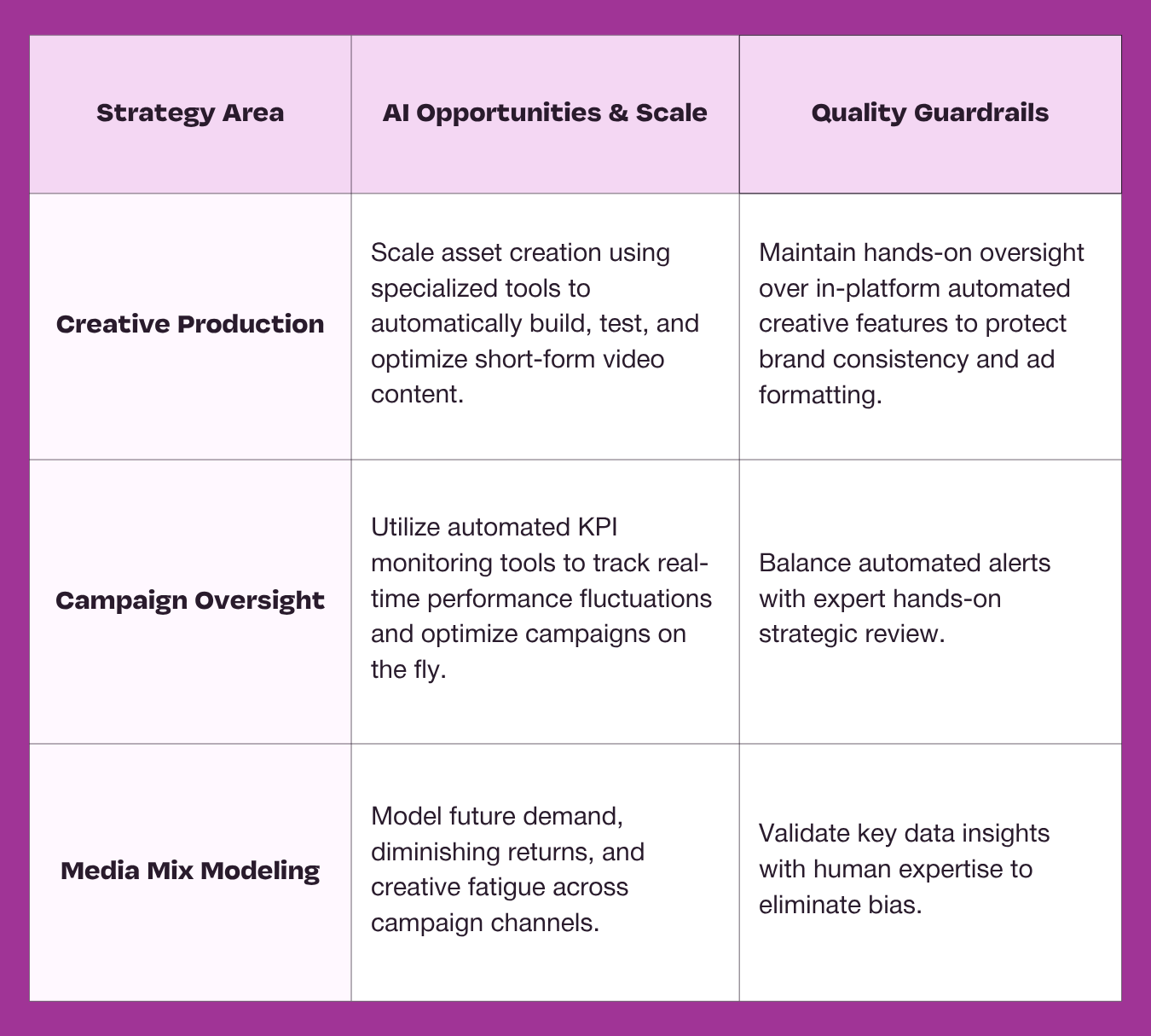
Scaling creative and operations with AI
AI serves as an efficiency enabler, allowing teams to scale short-form video production and maintain continuous campaign oversight.
Building a HIPAA-compliant patient acquisition engine
A predictable growth engine combines precise audience targeting with a privacy-first data strategy.
Analytics & tag management
Layering a Customer Data Platform (CDP) like Freshpaint or Ours Privacy on top of Google Analytics 4 (GA4) creates a HIPAA-compliant foundation by masking data and protecting privacy.
Call tracking & form solutions
AI-enabled call tracking (CallRail, Invoca) evaluates call outcomes, while HIPAA-compliant forms (Jotform, CRM forms, or Epic Cheers forms) securely capture appointment requests.
EHR & CRM integration
Connecting media spend to EHR data feeds (or using Epic Linksource) tracks online-booked appointments, tying marketing investments directly to patient volume and revenue.
Practical implementation steps for healthcare marketers
To build scale, efficiency, and demonstrable impact into your performance media strategy, healthcare marketers can execute these initiatives today:
- Refine keyword precision: Transition key clinical campaigns to exact match keywords, and maintain dedicated, capped campaigns for branded search.
- Deploy structured schema markup: Add rich schema markup across service lines and provider pages to maximize discoverability in AI search engines and LLMs.
- Transition display to programmatic: Shift display media spend to transparent programmatic channels that leverage propensity data and targeted audience modeling.
- Test emerging ad inventory: Reserve budget to test targeted Reddit ad placements and ChatGPT ad inventory for core service lines.
- Implement privacy layers: Ensure that web analytics and tagging infrastructure use a CDP privacy layer to sanitize data before transmission to the platform.
- Align with C-suite metrics: Transition reporting toward patient acquisition, lead volume, and return on investment to demonstrate clear business impact.
Sign up for True Intelligence
Stay inspired and informed. True Intelligence delivers innovative strategies and proven tactics to help you navigate the ever-evolving healthcare marketing landscape.
Request a strategy call
Meet with a marketing strategist to discuss your healthcare marketing goals.
Request a ConsultationThe latest healthcare marketing insights, delivered.
Explore the True Intelligence blog.


.png)
